Why CRMs Fail Relationship-Driven Businesses (And What Comes Next)
Sam Okpara
November 2025
Forty-seven overdue follow-ups. A VP who asked for a proposal two weeks ago and never heard back. A warm intro from a mutual contact, rotting quietly for eleven days. This is what a "relationship management system" looks like in practice: a graveyard of good intentions with a monthly subscription fee.
The problem is not a lack of data. Names, titles, deal stages, last-contacted dates -- it is all there, organized and useless, waiting for someone to context-switch out of actual work to play relationship archaeologist.
Every CRM on the market is built on the same foundational assumption: the value is in storing relationship data. That assumption is wrong. The value is in acting on relationship data at the right moment, in the right way. No CRM does this.
The gap where revenue dies quietly
For relationship-driven businesses -- consultancies, agencies, professional services firms, wealth management teams, anyone whose revenue comes from their network -- the storage problem was solved years ago. Salesforce, HubSpot, Pipedrive, and Close all store contacts, log activities, and generate reports.
But none of them answer the questions that actually matter: Who needs attention right now? What should I say to them? Which relationship is cooling off before it is too late to recover?
These platforms store data, then leave the actual hard work entirely to you. The result is predictable. Tuesday turns into Thursday, Thursday turns into three weeks of silence, and the moment passes. You do not lose relationships because of bad data. You lose them because the system never told you what to do with it.
This is the gap Relate was built to close.
What agentic relationship intelligence actually does
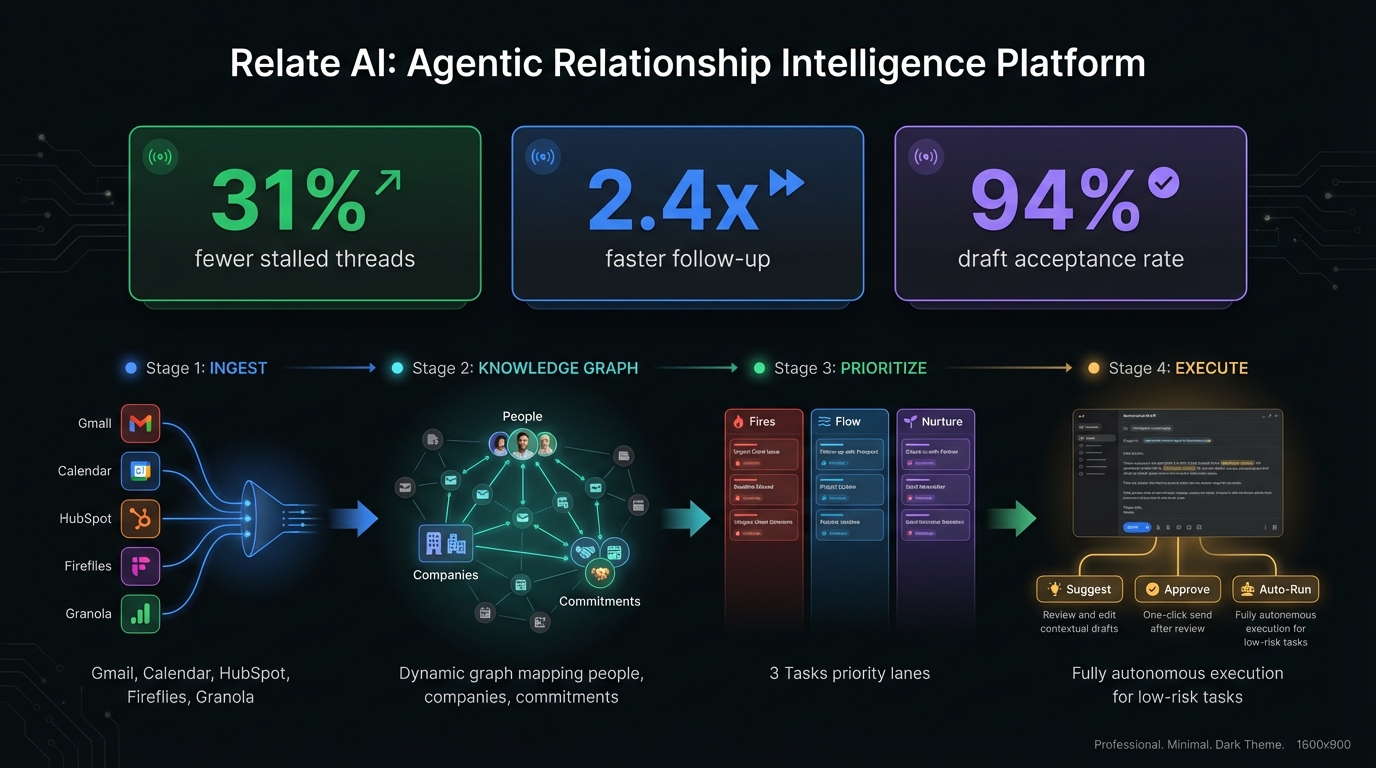
Relate is not a CRM. It does not ask you to log anything. It does not present a pipeline view and leave you to figure out the rest. It is an AI-native system that moves teams from data entry to action through four layers.
1. Omnichannel ingestion
Relate connects to your actual communication streams and pulls in relationship signals automatically:
- Gmail and Outlook for email history and threads
- Google Calendar for meeting context and scheduling patterns
- HubSpot for existing CRM data (optional — Relate does not require a CRM)
- Fireflies and Granola for meeting transcripts and notes
- LinkedIn integration coming soon
Nothing needs to be logged manually. The system reads your existing communication and builds context from it.
2. Dynamic knowledge graph
From those signals, Relate resolves a dynamic knowledge graph mapping people, companies, commitments, and historical context.
This goes beyond "John Smith, VP at Acme Corp." The graph captures that John mentioned his daughter's soccer tournament on the last call, that he has been at Acme for eighteen months, that he came from a company with a mutual contact, that he prefers Tuesday mornings for calls, and that his last three emails have been noticeably more formal than usual — which the system flags as a potential sentiment shift.
Open commitments are tracked automatically. If you promised to send revised pricing by Friday and have not done it, the system knows. If they promised to loop in their CTO and three weeks have passed, the system knows that too.
3. Deterministic prioritization
Every morning, Relate evaluates the entire knowledge graph and ranks which relationships need attention using a mathematical risk model based on recency, sentiment, and goals. This is deterministic logic — not LLM guessing.
The result surfaces in three priority lanes:
- Fires & Blockers. Needs attention today. Escalations, overdue commitments, unanswered leads, at-risk renewals. These surface first.
- Flow. Active relationships in good standing. Regular cadence, ongoing conversations, no intervention needed. Visible but not nagging.
- Nurture & Monitor. Dormant relationships worth maintaining. Former clients, conference connections, people who could matter later. Periodic touchpoints suggested automatically.
Routing recalculates daily. A "nurture" contact who suddenly emails about a new project jumps to "fires" automatically.
4. Execution with guardrails
For every prioritized action, Relate drafts the follow-up. Not a template — a contextual response that references the right project, matches the user's writing style, and picks up the thread naturally.
But nothing happens without human control. Relate provides three levels of AI autonomy:
Suggest mode. AI surfaces recommendations — talking points, relationship alerts, research. No action taken. You review and decide.
Approve mode. AI drafts the action — follow-up emails, meeting prep briefs, commitment updates. You review and approve before anything sends. Nothing goes out without a click.
Auto-run mode. Pre-approved routine actions execute automatically — CRM field updates, calendar sync, data enrichment. Full logging, fully reversible.
You set the boundary. The system respects it.
Where the numbers move
Early internal and user data shows meaningful shifts in the metrics that matter for relationship-driven work:
- 31% fewer stalled threads. Conversations that go silent because nobody followed up get caught before they flatline.
- 2.4x faster follow-up time. Not from working harder. The draft is already written when you open your laptop.
- 94% draft acceptance rate. Context does the heavy lifting. Most suggested responses go out with minimal edits.
For a consulting firm, wealth management team, or agency, stalled threads are slow-motion revenue loss. Every silent conversation is a deal, a partnership, or a referral cooling off one day at a time.
Who this is for (and who it is not for)
Relate is not for everyone. High-volume sales floors with hundreds of cold leads and a BDR army need traditional CRM pipeline automation. Different problem, different tool.
Relate is for people whose business runs on a smaller number of deeper relationships. Consultants. Agency principals. Professional services leaders. Wealth advisors. Investors. Anyone who has thought "I really should reach out to so-and-so" and then did not, because a delivery sprint ate the week and the window closed.
Honest about limitations:
- Relate requires access to communication streams. If email and calendar are locked down by IT policy, onboarding requires coordination.
- The knowledge graph takes a few weeks to build enough context for high-quality prioritization and drafts. It is not an instant payoff.
- For purely transactional sales motions (high volume, low touch), a traditional CRM with pipeline automation will serve better.
The underlying shift
CRMs were built for a world where the bottleneck was data storage. That world ended years ago. The bottleneck now is attention — knowing which of the hundreds of relationships in your network needs something from you today, and having the context to act on it without a fifteen-minute ramp-up.
Storing relationships in a database is table stakes. The next step is agentic intelligence that thinks about your relationships when you cannot, acts on them with your approval, and gets better the more you use it.
That is what Relate is building. If relationship-driven revenue is core to your business and your current CRM is mostly a place where follow-ups go to die, take a look.
Need help building something like this?
At Paramint, we build production AI systems, custom software, and internal tools for growth-stage startups, enterprises, and government agencies. We focus on solutions that deliver measurable impact — not just demos.
Get in touchRelated posts
Solving the Cold Start Problem: Building a Dating Profile Review Marketplace
Dating apps provide zero feedback on why profiles underperform. Building a two-sided marketplace to solve that reveals hard lessons in trust, pricing, and the cold start problem.
February 2026The RFP Response Problem: Why Expensive People Are Doing Document Assembly Work
RFP responses consume days of skilled labor on what is fundamentally document assembly. An 8-stage AI pipeline can reduce response time from days to hours while improving compliance rates.
December 2025